
Conformity Assessment and CE Certification Process
This page explains conformity assessment, stakeholder roles, CE certification modules, notified bodies, accreditation, technical files, product traceability and manufacturers' responsibilities.
Page Contents
- Conformity assessment and CE certification explained
- Assessment modules from A to H1
- Notified bodies, impartiality and accreditation
- CE marking, EU declarations of conformity and technical files
WHAT IS CONFORMITY ASSESSMENT (CE CERTIFICATION), AND HOW DOES IT WORK?
Conformity assessment is a verification activity demonstrating whether specified requirements relating to a product, process, system, person or organisation have been fulfilled.
As industry and business develop technologically and technical requirements increase, the ability to demonstrate that supplied products or services genuinely meet specified or claimed requirements becomes increasingly important.
Conformity assessment may apply to a product, including a service, a process, a system, an organisation or a person. It includes activities such as testing, inspection and certification. Its primary purpose is to demonstrate that products placed on the market meet the requirements of the relevant technical regulations. Products undergo assessment during design and production, under the manufacturer's responsibility.
Conformity assessment must be distinguished from market surveillance carried out by the relevant authorities. Conformity assessment takes place before a product is placed on the market.
Market surveillance takes place while a product is on the market. The two activities are complementary and equally necessary to protect the public interest and ensure that the internal market functions properly.
The principal participants are the legislator, the manufacturer and, where required by legislation, a notified body or accredited in-house conformity assessment body. Conformity assessment remains the manufacturer's responsibility, but a third party must be involved where the applicable legislation requires it.
There are three approaches to conformity assessment for CE marking:
1) The manufacturer's declaration, without third-party involvement:
This applies where the legislator considers that the manufacturer's declaration, supported by the relevant technical examinations and reports, is sufficient to establish conformity with the applicable technical regulation.
The manufacturer performs all necessary checks, prepares the technical reports and ensures the conformity of the production process. Where the technical regulation requires assessment by a notified body, the third approach applies.
2) An accredited in-house conformity assessment body:
Assessment is carried out by an accredited in-house conformity assessment body that forms part of the manufacturer's organisation.
The body must be independent of commercial interests and of design and production activities. Through accreditation, it must demonstrate the same technical competence and impartiality as an external conformity assessment body.
3) A notified body:
The legislator may require the involvement of an independent third party, namely an external conformity assessment body.
A notified body must be entirely independent and impartial in relation to the company assessed and the product's manufacturing process. It cannot undertake activities that conflict with its independence or hold other interests in the product it assesses. Further information about notified bodies is available on our website.
WHAT ARE THE STAKEHOLDERS' ROLES IN CONFORMITY ASSESSMENT FOR CE MARKING?
- Legislator
- Establishes the legal requirements that products must meet;
- Selects the conformity assessment modules and procedures.
- Manufacturer
- Designs, manufactures and tests the product;
- Prepares the product's technical documentation;
- Takes all necessary measures to ensure conformity;
- Following a favourable assessment, prepares the EU declaration of conformity and affixes the CE mark as required by legislation;
- Where a notified body is involved, adds its identification number to the product when required by the applicable legislation.
- Notified Conformity Assessment Body
- Performs checks and assessments required by the relevant legislation;
- Following a favourable assessment, issues the approval document required by that legislation;
- Fulfils its obligations to its accreditation body and the Ministry that authorised it.
WHAT ARE THE TYPES AND MODULES OF CONFORMITY ASSESSMENT FOR CE MARKING?
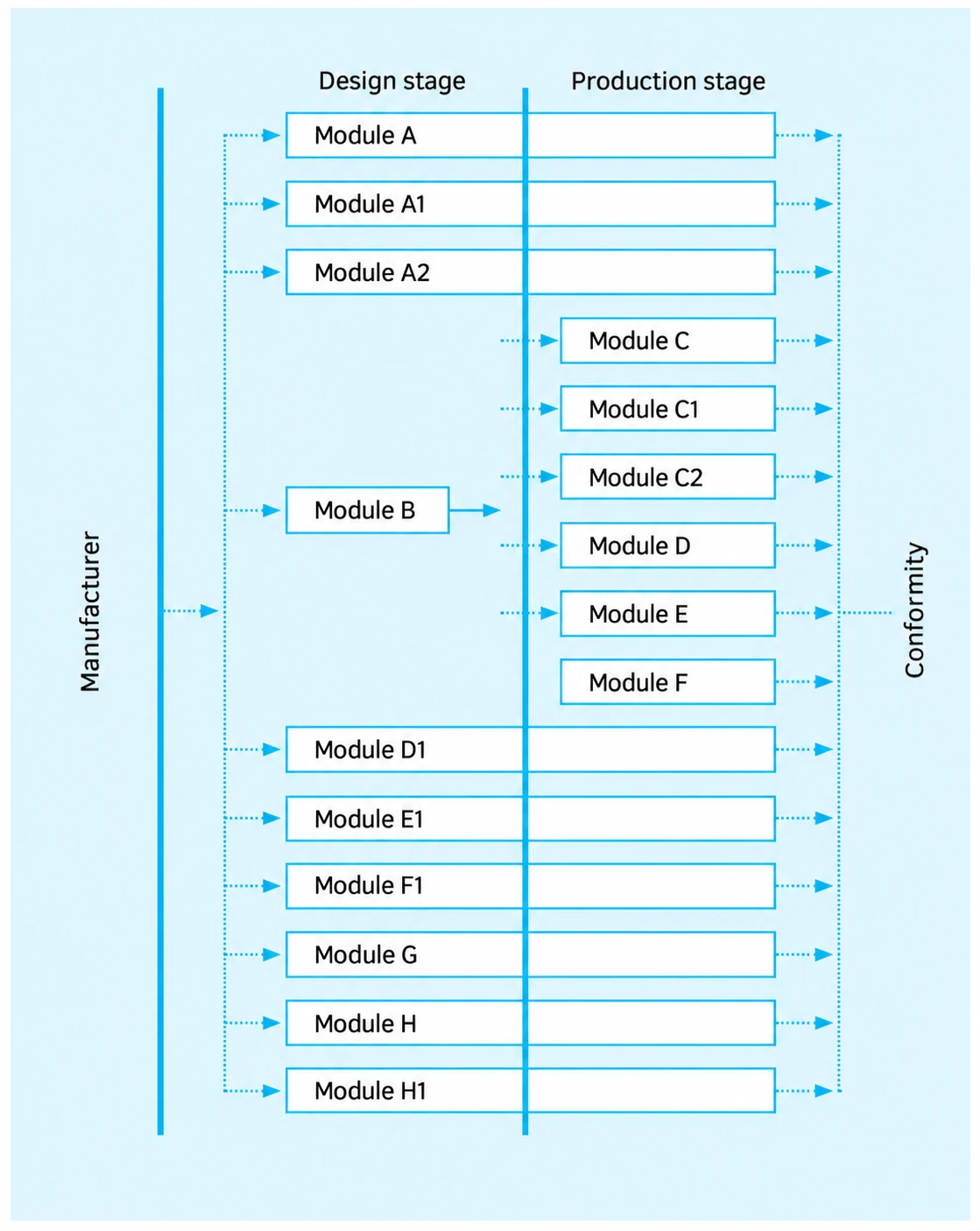
Module A — Internal Production Control
A conformity assessment procedure in which the manufacturer fulfils the requirements for technical documentation, manufacture and the EU declaration of conformity specified in the applicable product regulation, and declares under its sole responsibility that the product meets that regulation's requirements.
- The manufacturer:
- Prepares the technical file required by the applicable product regulation and, unless otherwise specified, retains it for 10 years so that it can be made available to the Ministry on request.
- Ensures that manufactured products meet the legal requirements;
- The manufacturer or its authorised representative:
- Affixes the CE mark;
- Prepares the EU declaration of conformity under the applicable product regulation and, unless otherwise specified, retains it for 10 years so that it can be made available to the Ministry on request.
- Conformity assessment body:
- No conformity assessment body is involved. The manufacturer performs all the necessary checks.
Module A1 — Internal Production Control plus Supervised Product Testing
Covers design and production, with tests on specific aspects of the product performed by an accredited body or under the responsibility of a notified body selected by the manufacturer.
The manufacturer:
- Prepares the technical file required by the applicable product regulation and, unless otherwise specified, retains it for 10 years so that it can be made available to the Ministry on request;
- Ensures that manufactured products meet the legal requirements;
- Performs tests on one or more aspects of the product, or has those tests performed on its behalf;
- Ensures that tests are performed by an accredited in-house conformity assessment body or under the responsibility of a notified body of its choice, and retains the records;
- Where testing is performed under a notified body's responsibility, affixes that body's identification number to the product during manufacture under the body's responsibility.
- The manufacturer or its authorised representative:
- Affixes the CE mark;
- Prepares the EU declaration of conformity under the applicable product regulation and, unless otherwise specified, retains it for 10 years so that it can be made available to the Ministry on request.
- Notified Body or Accredited In-House Body — selected by the manufacturer unless the regulation states otherwise. Accredited in-house body:
- Performs tests on one or more aspects of a product;
- Keeps records of its decisions and other relevant information;
- Informs the relevant Ministry and other bodies about its examinations. Notified body:
- Supervises and takes responsibility for tests on one or more aspects of the product performed by the manufacturer or on its behalf.
- Keeps records of its decisions and other relevant information;
- Fulfils its obligations to the Ministry regarding the examinations it performs.
Module A2 — Internal Production Control plus Supervised Product Checks at Random Intervals
A conformity assessment procedure in which the manufacturer fulfils the obligations for technical documentation, manufacture, final assessment and the EU declaration of conformity specified in the applicable product regulation, and declares under its sole responsibility that the product meets that regulation's requirements.
The manufacturer:
- Prepares the technical file required by the applicable product regulation and, unless otherwise specified, retains it for 10 years so that it can be made available to the Ministry on request;
- Ensures that manufactured products meet the legal requirements;
- Applies to a conformity assessment body of its choice for product checks;
- Where testing is performed under a notified body's responsibility, affixes that body's identification number to the product during manufacture under the body's responsibility.
The manufacturer or its authorised representative:
- Affixes the CE mark;
- Prepares the EU declaration of conformity under the applicable product regulation and, unless otherwise specified, retains it for 10 years so that it can be made available to the Ministry on request.
Notified Body or Accredited In-House Body — selected by the manufacturer unless the regulation states otherwise
- Performs product tests at irregular or random intervals determined by the body;
- Keeps records of its decisions and other relevant information;
- Fulfils its obligations to the Ministry regarding the examinations it performs.
Module B — EU-Type Examination
EU-type examination is the part of the conformity assessment procedure in which a notified body examines a product model's technical file and technical design and certifies that the design meets the applicable product regulation. It is followed by another module, such as C, C1, C2, D, E or F, demonstrating that production conforms to the approved EU type.
The manufacturer:
- Prepares the technical file required by the applicable product regulation and, unless otherwise specified, retains it for 10 years so that it can be made available to the Ministry on request;
- Verifies that the sample or samples meet the legal requirements.
Note: Module B covers the design stage only. It does not, by itself, permit the manufacturer to issue the declaration of conformity or affix the notified body's identification number to the product.
The manufacturer or its authorised representative:
- Applies to a notified body of its choice for Module B EU-type examination.
- Retains the technical file, EU-type examination certificate and other relevant information, keeping them available for the Ministry on request.
- Informs the notified body of every modification to the approved type.
The notified body:
- Examines the technical file and supporting documentation specified in the regulation;
- Verifies that the sample or samples have been manufactured in accordance with the legal requirements;
Note: The applicable product regulation determines the assessment method. Examination of a sample represents production-type Module B, while assessment of the technical file without examining a sample represents design-type Module B. Examining both the technical file and a sample combines these approaches.
- Performs the appropriate examinations and tests;
- Prepares the assessment report in agreement with the manufacturer;
- Issues the EU-type examination certificate;
- Keeps records of its decisions and other relevant information;
- Fulfils its obligations to the Ministry regarding the examinations it performs.
Module C — Conformity to EU Type Based on Internal Production Control
Follows Module B.
The manufacturer carries out internal checks, including production controls, to ensure that the product conforms to the EU type approved under Module B.
The manufacturer:
- Ensures that manufactured products conform to the EU type approved under Module B and meet the legal requirements.
The manufacturer or its authorised representative:
- Affixes the CE mark;
- Retains the approved technical file under Module B for 10 years, unless the regulation specifies otherwise, and keeps it available for the Ministry on request.
- Prepares the EU declaration of conformity under the applicable product regulation and, unless otherwise specified, retains it for 10 years so that it can be made available to the Ministry on request.
Conformity assessment body:
- No conformity assessment body is involved. The manufacturer performs all the necessary checks.
Module C1 — Conformity to EU Type Based on Internal Production Control plus Supervised Product Testing
Follows Module B.
The manufacturer arranges product testing by an accredited in-house body or under the responsibility of a notified body of its choice.
The manufacturer:
- Ensures that manufactured products conform to the EU type approved under Module B and meet the legal requirements.
- Performs tests on one or more aspects of the product, or has them performed on its behalf by a selected accredited in-house body or under a notified body's responsibility;
- Where testing is performed under a notified body's responsibility, affixes that body's identification number to the product during manufacture under the body's responsibility.
The manufacturer or its authorised representative:
- Affixes the CE mark;
- Retains the approved technical file under Module B and test decisions or reports for 10 years, unless otherwise specified, keeping them available for the Ministry on request.
- Prepares the EU declaration of conformity under the applicable product regulation and, unless otherwise specified, retains it for 10 years so that it can be made available to the Ministry on request.
Notified Body or Accredited In-House Body — selected by the manufacturer unless the regulation states otherwise
Accredited In-House Body
- Performs tests on one or more aspects of a product;
Note: The accredited in-house body takes the technical file into account but does not repeat its examination, as that was completed under Module B.
Notified Body
- Supervises and takes responsibility for tests on one or more aspects of the product performed by the manufacturer or on its behalf.
Note: The accredited in-house body takes the technical file into account but does not repeat its examination, as that was completed under Module B.
- Keeps records of its decisions and other relevant information;
- Fulfils its obligations to the Ministry regarding the examinations it performs.
Module C2 — Conformity to EU Type Based on Internal Production Control plus Supervised Product Checks at Random Intervals
Follows Module B.
The manufacturer fulfils the obligations for manufacture, final assessment and the EU declaration of conformity specified in the applicable regulation. It ensures and declares under its sole responsibility that the product conforms to the type described in the EU-type examination certificate and meets the relevant regulatory requirements.
The manufacturer:
- Ensures that manufactured products conform to the EU type approved under Module B and meet the legal requirements.
- Applies to a notified body of its choice for product checks;
- Where testing is performed under a notified body's responsibility, affixes that body's identification number to the product during manufacture under the body's responsibility.
The manufacturer or its authorised representative:
- Affixes the CE mark;
- Retains the approved technical file under Module B and test decisions or reports for 10 years, unless otherwise specified, keeping them available for the Ministry on request.
- Prepares the EU declaration of conformity under the applicable product regulation and, unless otherwise specified, retains it for 10 years so that it can be made available to the Ministry on request.
Notified Body or Accredited In-House Body — selected by the manufacturer unless the regulation states otherwise
- Performs product tests at irregular or random intervals determined by the body.
Note: The accredited in-house body and notified body take the technical file into account but do not repeat its examination, as that was completed under Module B.
Module D — Conformity to EU Type Based on Quality Assurance of the Production Process
Follows Module B.
The manufacturer fulfils the obligations for manufacture and the EU declaration of conformity specified in the applicable regulation. It ensures and declares under its sole responsibility that the product conforms to the type described in the EU-type examination certificate and meets the relevant regulatory requirements.
The manufacturer:
- Operates an approved quality system for production, final product inspection and testing to ensure conformity with the EU type approved under Module B and the relevant technical regulation;
The documented quality system must cover quality objectives, organisational structure, manufacturing and quality-control techniques, tests performed before, during and after manufacture, quality records and monitoring methods.
- Fulfils the obligations arising from the quality system, including record-keeping and reporting;
- Ensures that manufactured products conform to the EU type approved under Module B and the relevant technical regulation.
The manufacturer or its authorised representative:
- Applies to a notified body of its choice for assessment of the quality system;
- Informs the notified body of every change to the quality system;
- Retains the approved technical file under Module B and test decisions or reports for 10 years, unless otherwise specified, keeping them available for the Ministry on request.
- Prepares the EU declaration of conformity under the applicable product regulation and, unless otherwise specified, retains it for 10 years so that it can be made available to the Ministry on request.
- Affixes the CE mark;
- Affixes the notified body's identification number under that body's responsibility.
The notified body:
- Carries out regular audits to assess and examine the quality system, including review of the technical file, checks of the quality system, examinations and product tests;
- Keeps records of its decisions and other relevant information;
- Fulfils its obligations to the Ministry regarding the examinations it performs.
Module D1 — Quality Assurance of the Production Process
A conformity assessment procedure in which the manufacturer fulfils the requirements for technical documentation, manufacture and the EU declaration of conformity specified in the applicable product regulation, and declares under its sole responsibility that the product meets that regulation's requirements.
The manufacturer:
- Prepares the technical file required by the applicable product regulation and, unless otherwise specified, retains it for 10 years so that it can be made available to the Ministry on request;
- Operates an approved quality system for production, final product inspection and testing to ensure that manufactured products meet the legal requirements.
The documented quality system must cover quality objectives, organisational structure, manufacturing and quality-control techniques, tests performed before, during and after manufacture, quality records and monitoring methods.
- Fulfils the obligations arising from the quality system, including record-keeping and reporting;
- Ensures that manufactured products comply with the relevant technical regulation.
The manufacturer or its authorised representative:
- Applies to a notified body of its choice for assessment of the quality system;
- Informs the notified body of every change to the quality system;
- Retains the product technical file for 10 years, unless the regulation specifies otherwise, and keeps it available for the Ministry on request.
- Prepares the EU declaration of conformity under the applicable product regulation and, unless otherwise specified, retains it for 10 years so that it can be made available to the Ministry on request.
- Affixes the CE mark;
- Affixes the notified body's identification number under that body's responsibility.
The notified body:
- Carries out regular audits to assess and examine the quality system, including review of the technical file, checks of the quality system, examinations and product tests;
- Keeps records of its decisions and other relevant information;
- Fulfils its obligations to the Ministry regarding the examinations it performs.
Module E — Conformity to EU Type Based on Product Quality Assurance
Follows Module B.
The manufacturer fulfils the obligations for manufacture and the EU declaration of conformity specified in the applicable regulation. It ensures and declares under its sole responsibility that the product conforms to the type described in the EU-type examination certificate and meets the relevant regulatory requirements.
The manufacturer:
- Operates an approved quality system for final product inspection and testing to ensure conformity with the EU type approved under Module B and the relevant technical regulation;
The documented quality system must cover quality objectives, organisational structure, manufacturing and quality-control techniques, post-manufacture tests, quality records and monitoring methods.
Note: Tests performed before or during manufacture, and manufacturing techniques, are not included in the quality system under Module E; these are covered by Modules D and D1. Module E focuses on finished-product quality rather than the entire production process.
- Fulfils the obligations arising from the quality system, including record-keeping and reporting;
- Ensures that manufactured products conform to the EU type approved under Module B and the relevant technical regulation.
The manufacturer or its authorised representative:
- Applies to a notified body of its choice for assessment of the quality system;
- Informs the notified body of every change to the quality system;
- Retains the approved technical file under Module B and test decisions or reports for 10 years, unless otherwise specified, keeping them available for the Ministry on request.
- Prepares the EU declaration of conformity under the applicable product regulation and, unless otherwise specified, retains it for 10 years so that it can be made available to the Ministry on request.
- Affixes the CE mark;
- Affixes the notified body's identification number under that body's responsibility.
The notified body:
- Carries out regular audits to assess and examine the quality system, including system checks, examinations and product tests;
Note: The notified body takes the technical file into account but does not repeat its examination, as that was completed under Module B.
- Keeps records of its decisions and other relevant information;
- Fulfils its obligations to the Ministry regarding the examinations it performs.
Module E1 — Quality Assurance of Final Product Inspection and Testing
A conformity assessment procedure in which the manufacturer fulfils the requirements for technical documentation, manufacture and the EU declaration of conformity specified in the applicable product regulation, and declares under its sole responsibility that the product meets that regulation's requirements.
The manufacturer ensures the conformity of finished products, while the notified body evaluates the arrangements used to verify that conformity. The approach is similar to Module D1, but E1 focuses on final product inspection and testing. D1 covers the whole production process as well as final product testing; E1 omits the provisions concerning the production process itself.
The manufacturer:
- Prepares the technical file required by the applicable product regulation and, unless otherwise specified, retains it for 10 years so that it can be made available to the Ministry on request;
- Operates an approved quality system for final product inspection and testing to ensure that manufactured products meet the legal requirements.
The documented quality system must cover quality objectives, organisational structure, manufacturing and quality-control techniques, post-manufacture tests, quality records and monitoring methods;
Note: Tests performed before or during manufacture, and manufacturing techniques, are not included in the quality system under Module E1; these are covered by Modules D and D1. Module E1 focuses on finished-product quality rather than the entire production process.
- Fulfils the obligations arising from the quality system, including record-keeping and reporting;
- Ensures that manufactured products comply with the relevant technical regulation.
The manufacturer or its authorised representative:
- Applies to a notified body of its choice for assessment of the quality system;
- Informs the notified body of every change to the quality system;
- Retains the product technical file for 10 years, unless the regulation specifies otherwise, and keeps it available for the Ministry on request.
- Prepares the EU declaration of conformity under the applicable product regulation and, unless otherwise specified, retains it for 10 years so that it can be made available to the Ministry on request.
- Affixes the CE mark;
- Affixes the notified body's identification number under that body's responsibility.
The notified body:
- Carries out regular audits to assess and examine the quality system, including review of the technical file, checks of the quality system, examinations and product tests;
- Keeps records of its decisions and other relevant information;
- Fulfils its obligations to the Ministry regarding the examinations it performs.
Module F — Conformity to EU Type Based on Product Verification
Follows Module B.
The manufacturer fulfils the obligations for manufacture and the EU declaration of conformity specified in the applicable regulation. It ensures and declares under its sole responsibility that the product conforms to the type described in the EU-type examination certificate and meets the relevant regulatory requirements.
The manufacturer ensures that manufactured products conform to the approved EU type. The notified body verifies conformity through individual product tests or statistical checks. Module F resembles C2, but the notified body's product checks are more systematic.
The manufacturer:
- Ensures that manufactured products conform to the EU type approved under Module B and meet the legal requirements.
- Where statistical verification is used during final product inspection and testing, the manufacturer takes all necessary measures to ensure consistent production and monitoring for each batch and presents products for verification in homogeneous batches.
The manufacturer or its authorised representative:
- Applies to a notified body of its choice.
- Affixes the CE mark;
- Retains the approved technical file under Module B and test decisions or reports for 10 years, unless otherwise specified, keeping them available for the Ministry on request.
- Prepares the EU declaration of conformity under the applicable product regulation and, unless otherwise specified, retains it for 10 years so that it can be made available to the Ministry on request.
- Affixes the notified body's identification number under that body's responsibility.
The notified body:
- Performs appropriate examinations or tests, either on each product or through statistical checks.
- If a batch is rejected during statistical verification, the notified body takes the necessary measures to prevent it from being placed on the market. If batches are repeatedly rejected, the body suspends statistical verification and takes appropriate action.
Note: The notified body takes the technical file into account but does not repeat its examination, as that was completed under Module B.
- Issues a certificate of conformity;
- Affixes its identification number or authorises the manufacturer to affix it;
- Keeps records of its decisions and other relevant information;
- Fulfils its obligations to the Ministry regarding the examinations it performs.
Module G — Conformity Based on Unit Verification
The manufacturer fulfils the technical-file and EU-declaration obligations specified in the applicable product regulation and ensures and declares, under its sole responsibility, that the product meets the regulatory requirements. The notified body verifies each product against the legal requirements, rather than against an approved EU type.
The manufacturer:
- Prepares the technical file required by the applicable product regulation and, unless otherwise specified, retains it for 10 years so that it can be made available to the Ministry on request;
- Ensures that manufactured products meet the legal requirements.
- Applies to a notified body of its choice for product checks.
The manufacturer or its authorised representative:
- Affixes the CE mark.
- Affixes the notified body's identification number under that body's responsibility.
- Retains the product technical file for 10 years, unless the regulation specifies otherwise, and keeps it available for the Ministry on request.
- Prepares the EU declaration of conformity under the applicable product regulation and, unless otherwise specified, retains it for 10 years so that it can be made available to the Ministry on request.
The notified body:
- Performs appropriate examinations;
- Issues a certificate of conformity;
- Keeps records of its decisions and other relevant information;
- Fulfils its obligations to the Ministry regarding the examinations it performs.
Module H — Conformity Based on Full Quality Assurance
The manufacturer fulfils the manufacturing and EU-declaration obligations specified in the applicable product regulation and declares under its sole responsibility that the product meets the regulatory requirements. It operates a full quality assurance system to ensure compliance with the legal requirements, rather than with an approved EU type. The notified body assesses the quality system.
The manufacturer:
- Prepares the technical file required by the applicable product regulation and, unless otherwise specified, retains it for 10 years so that it can be made available to the Ministry on request;
- Operates an approved quality system for production, final product inspection and testing.
The documented quality system must cover quality objectives, organisational structure, manufacturing and quality-control techniques, tests performed before, during and after manufacture, quality records and monitoring methods.
- Fulfils the obligations arising from the quality system, including record-keeping and reporting;
The manufacturer or its authorised representative:
- Applies to a notified body of its choice for assessment of the quality system;
- Informs the notified body of every change to the quality system;
- Retains the product technical file for 10 years, unless the regulation specifies otherwise, and keeps it available for the Ministry on request.
- Prepares the EU declaration of conformity under the applicable product regulation and, unless otherwise specified, retains it for 10 years so that it can be made available to the Ministry on request.
- Affixes the CE mark;
- Affixes the notified body's identification number under that body's responsibility.
The notified body:
- Carries out regular audits to assess and examine the quality system, including review of the technical file, checks of the quality system, examinations and product tests;
- Keeps records of its decisions and other relevant information;
- Fulfils its obligations to the Ministry regarding the examinations it performs.
Module H1 — Conformity Based on Full Quality Assurance plus Design Examination
A conformity assessment procedure in which the manufacturer fulfils the manufacturing and EU-declaration obligations specified in the applicable product regulation and declares under its sole responsibility that the product meets the relevant regulatory requirements.
The manufacturer operates a full quality assurance system to ensure compliance with legal requirements, rather than an approved EU type. The notified body assesses both the quality system and the product design and issues an EU design examination certificate. Compared with Module H, H1 requires a more detailed examination of the product design.
The EU design examination certificate must be distinguished from the Module B type-examination certificate, which establishes the conformity of a sample representative of the intended production. Under Module B, production can be checked against that sample. Module H1 does not use such a sample: its certificate confirms that the notified body has examined and approved the conformity of the product design.
The manufacturer:
- Prepares the technical file required by the applicable product regulation and, unless otherwise specified, retains it for 10 years so that it can be made available to the Ministry on request;
- Operates an approved quality system for production, final product inspection and testing.
The documented quality system must cover quality objectives, organisational structure, manufacturing and quality-control techniques, tests performed before, during and after manufacture, quality records and monitoring methods.
- Fulfils the obligations arising from the quality system, including record-keeping and reporting;
- Ensures that manufactured products comply with the approved EU design and the relevant technical regulation.
The manufacturer or its authorised representative:
- Applies to a notified body of its choice for EU design examination; the same body also assesses the quality system;
- Informs the notified body of every change to the EU design or quality system;
- Retains the product technical file for 10 years, unless the regulation specifies otherwise, and keeps it available for the Ministry on request.
- Prepares the EU declaration of conformity under the applicable product regulation and, unless otherwise specified, retains it for 10 years so that it can be made available to the Ministry on request.
- Affixes the CE mark;
- Affixes the notified body's identification number under that body's responsibility.
The notified body:
- Examines the product design;
- Issues an EU design examination certificate;
- Carries out regular audits to assess and examine the quality system, including review of the technical file, checks of the quality system, examinations and product tests;
- Keeps records of its decisions and other relevant information;
- Fulfils its obligations to the Ministry regarding the examinations it performs.

HOW DO I SELECT THE APPROPRIATE CONFORMITY ASSESSMENT MODULE FOR CE MARKING?
The least burdensome module that adequately protects the public interest should be selected. Its complexity must be proportionate to the nature of production, the complexity of the product design and the risks the product presents to health, safety, the environment and other public interests.
The following principles are considered when selecting a conformity assessment module suitable for the activity:
- As a general rule, products are subject to assessment of both design and production before entering the market.
- Module A may be appropriate for products with a simple design and production process and a low risk to the public interest, where the manufacturer can perform all checks needed to ensure conformity.
- For series production based on a type or sample, where the design is complex and the risk of nonconformity is high, a two-stage procedure may be selected: first Module B EU-type examination of the representative prototype or sample, followed by a module establishing conformity of production with the approved EU type, such as C, C1, C2, D, E or F.
Where conformity is demonstrated against a sample approved under Module B, Module C may be selected if the manufacturer is capable of carrying out all the checks necessary to ensure production conformity.
- For new, innovative and complex products, Modules A1 or A2 may be selected. Where assessment is based on a sample approved under Module B, Modules C1 or C2 may be appropriate.
- Where conformity with the approved EU type cannot be left solely to the manufacturer and requires notified-body supervision during production, the manufacturer may be required to operate an approved quality system under Module D or E, or have product conformity verified by testing. If the production process is relatively simple, focusing on final product testing without including the manufacturing stage in the quality system may be sufficient; in that case, Module E may be appropriate.
- For products with a simple design but a complex manufacturing process, Modules D1, E1 or F1 may be selected.
- Module H may be appropriate for complex situations requiring a full quality system covering both design and production.
- Module H1 may be selected where the manufacturer operates a full quality assurance system and a notified body must examine the design and issue an EU design examination certificate.

WHAT IS A NOTIFIED BODY?
A notified body is a conformity assessment body designated by the competent authority in Türkiye or an EU member state, generally the Ministry responsible for the relevant regulation, to carry out specified assessment activities under a technical regulation. The designation follows the applicable legal requirements, and the body's name is notified to the European Commission.
Under the Customs Union Agreement with the EU, Türkiye undertook to align its technical product legislation with EU requirements. This alignment also confers certain rights. Through an Association Council Decision, Türkiye obtained the right to designate its own notified bodies under the legislation it has harmonised.
Notified bodies provide the independent third-party testing or certification required before certain products are placed on the market with CE marking. Manufacturers and exporters can therefore obtain these services from national organisations. The EU's NANDO database lists notified bodies operating in Türkiye and their authorised scopes. FQC STANDARD Uygunluk Değerlendirme A.Ş. operates as a designated notified body under identification number 2674.
Key Characteristics of Notified Bodies;
- They may provide conformity assessment services for CE marking to economic operators established inside or outside the EU;
- They operate competently, transparently, independently and impartially, without discrimination;
- They employ personnel with the knowledge and experience needed to assess conformity under the relevant legislation;
- They must maintain the confidentiality of information obtained during conformity assessment;
- They carry insurance covering their professional activities;
- They demonstrate their competence through accreditation.

WHAT DOES IMPARTIALITY MEAN IN CERTIFICATION?
Impartiality requires conformity assessment bodies to make certification decisions objectively and without bias.
This means avoiding conflicts of interest with applicants and ensuring that commercial, financial or other pressures do not influence the certification body.
In practice, impartiality also means that the certification decision is made by someone other than the personnel who carried out the assessment.

HOW CAN I CHECK THAT MY CERTIFICATE IS VALID?
The accreditation mark of an EA MLA signatory, such as TÜRKAK in Türkiye, on a certification body's certificate acts as a passport for trade. The confidence created by accreditation helps avoid repeated certification in each destination country and facilitates the movement of goods and services across borders in Europe and internationally.
Current accreditation and authorisation can be checked on the official websites of the Turkish Accreditation Agency (TÜRKAK) and the European Commission. FQC STANDARD UYGUNLUK DEĞERLENDİRME A.Ş. holds TÜRKAK accreditation and European Commission notified body authorisation for the relevant scopes. For information about our services, visit www.fqcstandard.com.tr or use the links below to check accreditation and authorisation details.
TÜRKAK Accreditation Enquiry: https://secure.turkak.org.tr/kapsam/search
European Commission Authorisation Enquiry: https://ec.europa.eu/growth/tools-databases/nando/
To check a certificate's reliability, follow these steps:
- Check whether the certificate bears an accreditation mark, such as TÜRKAK's;
- Check whether the mark belongs to an accreditation body that is a signatory to the relevant EA, ILAC or IAF mutual recognition arrangement;
- Check that the certification body is accredited for the scope you need. For TÜRKAK, use https://secure.turkak.org.tr/kapsam/search ),
- Check whether testing was performed against international standards or whether the standards and methods used are accepted in the destination country;
- Use the certification body's website to verify the certificate.

WHAT IS ACCREDITATION?
Accreditation is confirmation by a national accreditation body, based on harmonised standards, that a conformity assessment body has the technical competence to perform a specified assessment activity. It provides objectively verifiable criteria for establishing mutual confidence.
Accreditation always relates to a defined scope and evaluates a conformity assessment body's ability to perform particular tasks. Acting in the public interest, it assesses technical competence, reliability and integrity through a transparent and impartial process based on internationally recognised standards and other requirements.
WHAT ARE THE BENEFITS OF ACCREDITATION?
Accreditation provides a final layer of public oversight in the conformity assessment chain, supporting product safety. It also strengthens confidence and consistency in the public interest by facilitating the free movement of products and services across the EU. Its benefits can be summarised as follows:
For National Governments and Regulators:
- Verifiable compliance with standards and applicable requirements;
- Greater confidence in suppliers of products and services, supporting trade and economic growth;
- Reduced costs and resource demands through the removal of duplicated obligations;
- Less need to employ specialist assessment staff for regulatory checks, and fewer repeated inspections.
For Industry and Business:
- Stronger competitiveness: accredited certificates provide objective evidence of technical competence, impartiality and compliance with international requirements, helping businesses differentiate their services and avoid retesting costs;
- Fewer checks and improved quality: importing goods and services supported by accredited certificates can reduce risk and cost because less additional evidence is needed;
- Support for exports: international recognition of accredited certificates reduces trade barriers and creates opportunities in global markets.
For Consumers and Citizens:
- Greater confidence in the market: consumers can trust products and services that have been checked by an independent, competent organisation;
- Protection of the public interest: accreditation helps safeguard consumers throughout the supply chain.

WHAT IS MARKET SURVEILLANCE?
Market surveillance is the activity through which public authorities responsible for technical product legislation, such as the relevant Ministry, inspect or arrange inspection of products during market placement, distribution or availability. It checks whether products have been manufactured in accordance with the applicable technical regulation and whether they are safe.
Its primary purpose is to ensure that products are placed or made available on the market in a way that protects human health, life and property. This prevents unsafe products from reaching consumers and helps maintain fair competition by addressing the unfair advantage created by noncompliant goods.
Market surveillance authorities balance consumer and producer interests. They also support manufacturers, particularly small and medium-sized businesses, in meeting obligations introduced by new legislation. Where human health is involved, however, protection of consumers takes priority.
WHAT CHECKS ARE CARRIED OUT DURING MARKET SURVEILLANCE?
Product safety inspections and the resulting measures directly affect both producers and consumers. Consumers need protection from products that could harm their health or safety, while manufacturers also consider their revenue and their products' reputation in the market.
The manufacturer, authorised representative and/or importer is responsible for the safety of products placed on the market. Public authorities check whether these obligations are met during importation, market placement or while the products are available on the market.
Market surveillance provides for the withdrawal of unsafe, noncompliant products and proportionate sanctions against businesses that breach the requirements. Checks may take place at different stages after market entry, including distribution, use or final use, and at locations such as importers' premises, wholesalers, retailers, rental businesses and users' sites.
Authorities may examine a product more closely where it presents a risk to health, safety or other public interests. Action may follow an accident, a complaint or an economic operator's notification of a risky product. Where a serious risk exists, the authorities assess the product against the relevant technical legislation, taking account of existing conformity assessment results and performing the necessary tests and evaluations.
First Level of Inspection:
Documentary and visual checks, such as the presence and correct application of the CE mark, availability of the EU declaration of conformity, and selection of the appropriate conformity assessment procedure. More detailed checks may be needed to verify correct application of the procedure, compliance with essential requirements and the declaration's contents.
Second Level of Inspection:
In practice, market surveillance may focus on particular aspects of the requirements. Other public oversight mechanisms can also reveal nonconformity, even when they were not established specifically for product surveillance. For example, occupational health and safety specialists checking a workplace may discover that CE-marked machinery or personal protective equipment does not meet the applicable design and construction requirements. Information may emerge from inspections or investigations following an accident. Complaints from consumers or other users, including concerns about products or unfair competition involving manufacturers or distributors, can also inform market surveillance.
Market surveillance authorities assess risk to determine whether a product presents a serious hazard, considering both the nature of the hazard and the likelihood of harm.
Where a product threatens health, safety or another public interest, the authorities may require economic operators to take one or more of the following actions:
- Take corrective action to bring the product into conformity;
- Withdraw the product from the market;
- Recall the product;
- Suspend supply of the product for a period.
Publicising measures taken to protect consumers' health is also an important part of market surveillance.
WHAT IS THE CE MARK?
The CE mark indicates that a product covered by the relevant EU New Approach legislation complies with that legislation and has undergone all required conformity assessment procedures. These are performed by the manufacturer or its authorised representative and, where required, by a third-party conformity assessment body known as a notified body.
WHY IS CE MARKING IMPORTANT?
CE marking is mandatory for products covered by the relevant EU New Approach legislation when they are placed on the market in EU member states or Türkiye. It functions as a passport enabling their free movement within the EU. Because Türkiye implements harmonised EU product legislation, products placed on the Turkish market must also bear the CE mark once the applicable requirements enter into force.
A product that requires CE marking cannot be exported to EU member states without it. Similarly, products covered by harmonised regulations that have entered into mandatory application in Türkiye cannot be placed on the domestic market without the required CE mark.
WHICH PRODUCTS REQUIRE CE MARKING?
The EU's NANDO database lists notified bodies operating in Türkiye and their authorised scopes. FQC STANDARD Uygunluk Değerlendirme A.Ş. operates as a designated notified body under identification number 2674.
The product regulations and categories addressed below include:
FQC STANDARD's experienced and competent team can quickly help determine whether your product falls within a mandatory regulatory scope.
- Medical devices;
- Hot-water boilers;
- Machinery;
- Electrical appliances;
- Toys;
- Transportable pressure equipment (π marking under its specific legislation);
- Construction products;
- Recreational craft and personal watercraft;
- Simple pressure vessels;
- Pressure equipment;
- Lifts;
- Personal protective equipment;
- Gas appliances.
WHAT DOES THE CE MARK ON A PRODUCT MEAN?
CE-marked products are presumed to comply with the relevant EU harmonisation legislation and to benefit from free movement in the European and domestic markets. The mark is the visible outcome of the conformity assessment process and shows that the manufacturer has declared compliance with the applicable requirements. It does not indicate that the product was manufactured in the EU.
CE marking represents fulfilment of the manufacturer's applicable obligations. EU member states presume that CE-marked products comply with the relevant legislation. Unless the marking provisions have been applied incorrectly, the manufacture or market access of compliant CE-marked products may not be prohibited, restricted or obstructed.
WHAT DOES AFFIXING THE CE MARK INVOLVE?
By affixing the CE mark, the manufacturer accepts responsibility for the product's compliance with all applicable EU requirements and for the successful completion of the relevant conformity assessment procedures.
HOW IS THE CE MARK AFFIXED?
The mark must be visible, legible and indelible on the product or its data plate. Where the product's nature makes this impossible, it is placed on the packaging and/or accompanying documents as permitted by the legislation. In principle, it is not affixed until conformity assessment is complete and compliance with all applicable provisions has been established. It is usually applied at the end of production, for example on a data plate attached after final inspection. Where it is stamped or cast into the product, it may be applied earlier, provided conformity is verified as part of production. Visibility means that the mark must be readily accessible to the parties concerned; it may, for example, be on the back or underside of the product.
Visibility does not mean that the CE mark must be visible before the packaging is opened. Marking the packaging is mandatory only where the relevant EU legislation expressly requires it. The mark must normally be at least 5 mm high to remain legible.
The CE mark may vary in colour or be solid, outlined, raised or recessed, provided it remains visible, legible and correctly proportioned. Direct marking may be impossible for certain products, such as some explosives, or impracticable under reasonable technical or economic conditions.
Where the minimum dimensions cannot be met, or visible, legible and indelible marking cannot be assured, the mark may be placed on available packaging and/or accompanying documents where the applicable legislation permits this.
The CE mark must not be omitted or moved to packaging or accompanying documents solely for aesthetic reasons.
Where the legislation requires a notified body to participate in production control, its identification number follows the CE mark. The manufacturer or authorised representative affixes that number under the notified body's responsibility where required.
The manufacturer retains ultimate responsibility for compliance with EU harmonisation legislation and for affixing the CE mark. By applying it, the manufacturer declares under its own responsibility that all legal requirements for the marking have been met, regardless of whether a third party participated in the assessment.
An importer, distributor or other operator that places a product on the market under its own name or trade mark, or modifies it in a way affecting conformity, assumes the manufacturer's responsibilities. These include responsibility for conformity and CE marking, so the operator must have sufficient knowledge of the product's design and manufacture.
MAY OTHER MARKS APPEAR ON A CE-MARKED PRODUCT?
The CE mark is the mark indicating conformity with the applicable EU harmonisation requirements. Other marks with a different meaning may be used if they do not impair its visibility or legibility or create confusion with it. Such marks should contribute to consumer protection and relate to matters outside the meaning of CE marking.

WHAT IS AN EU DECLARATION OF CONFORMITY?
An EU declaration of conformity states that a product meets the applicable requirements of its product legislation. It records the manufacturer's or authorised representative's declaration of compliance with harmonised EU requirements before the product is placed on the European Economic Area market.
WHAT SHOULD BE CONSIDERED WHEN PREPARING AN EU DECLARATION OF CONFORMITY?
The declaration must identify the manufacturer and its address and provide product details such as the brand and serial number. It must be signed by an authorised person acting for the manufacturer or authorised representative, with their position stated. The manufacturer must prepare and sign it whether or not a notified body is involved, thereby accepting responsibility for conformity. Unless the legislation specifies another period, it must be retained for 10 years after the product is placed on the market. Where several legislative acts apply, a single declaration should cover all of them.
WHAT INFORMATION DOES THE EU DECLARATION OF CONFORMITY CONTAIN?
- A number identifying the product. It need not be unique to each individual item and may refer to a product, batch, type or serial number, at the manufacturer's discretion;
- The name and address of the manufacturer or authorised representative preparing the declaration;
- A statement that the declaration is issued under the manufacturer's responsibility;
- A description allowing traceability, supplementing the identifying number with information that clearly identifies the product;
- References to the harmonised standards used and, where appropriate, other standards and regulations applied;
- Where a notified body is involved, its name and identification number and a reference to the relevant certificate, where applicable;
- The authorised person's signature and position, or an equivalent identification, and the date of issue, which must follow completion of conformity assessment.

WHAT IS A TECHNICAL FILE?
A technical file provides information about a product's design, manufacture and operation. The manufacturer must prepare the information needed to demonstrate compliance with the applicable requirements. The file must exist when the product is placed on the market, regardless of its geographical origin or location.
Unless the legislation specifies another period, the manufacturer must retain the technical file for 10 years after the product is placed on the market.
WHAT DOES A TECHNICAL FILE CONTAIN?
The applicable product regulation specifies the contents. As a general rule, the file describes the product and its intended use and covers its design, manufacture and operation.
The level of detail depends on the nature of the product and must demonstrate compliance with the regulation's essential requirements or show how the harmonised standards applied address those requirements.
Adequate risk analysis and assessment require the manufacturer to identify all potential risks and determine the applicable essential requirements. The analysis must be documented in the technical file, together with an assessment of how the identified risks have been addressed to ensure conformity.
Where a harmonised standard is applied only in part, or does not cover all applicable essential requirements, the technical file must explain how the remaining requirements have been addressed.
If a product is redesigned and reassessed, the technical file must cover all versions, describe the changes, explain how the versions can be identified and include the relevant conformity assessment information.
This prevents market surveillance authorities from receiving documentation for an earlier version instead of the product they are examining during its life cycle.

HOW SHOULD PRODUCT TRACEABILITY BE ENSURED?
A fundamental traceability requirement is to identify the manufacturer and, for imported products, the importer by name and address on the product. This allows market surveillance authorities to contact the operator responsible for supplying an unsafe or noncompliant product to the EU market promptly.
Traceability Requirements:
- Manufacturers must state their name, registered trade name or registered trade mark and a contact address on the product. Where this is not possible, the information must appear on the packaging or an accompanying document. The address must identify a single contact point for the manufacturer.
As a rule, the name and address belong on the product. An exception may be justified where direct marking is not practicable under reasonable technical or economic conditions; aesthetics alone are not a valid reason. The manufacturer must assess the product's size and nature. Hearing aids, sensors and similar small products may be too small to carry the information. In such cases, the first alternative is the packaging, followed by an accompanying document. The address must provide one contact point, particularly for market surveillance authorities. It need not be the manufacturer's registered address; it may be an authorised representative's or customer-service address.
- Manufacturers must ensure that products carry a type, batch, serial or model number, or another identifying element. Where the product's size or nature requires it, the information may be provided on the packaging or an accompanying document.
A product must carry a type, batch, serial or model number, or another identifier. Identification normally appears on the product. An exception is possible where its size or nature would make the marking illegible or technically impossible. In those circumstances, identification must appear on available packaging and/or an accompanying document. It must not be omitted for purely aesthetic or economic reasons. The manufacturer is responsible for the assessment. If there is no packaging or accompanying document, the product itself must carry the identifier. Manufacturers may choose the identifying element provided it ensures traceability. It must clearly link the specific product type to the relevant conformity documents, particularly the EU declaration of conformity, and match the identifier used in that declaration. The choice is also important for recalls and withdrawals, as all products bearing the same identifier may need to be affected.
Traceability of Products Made Up of Separate Parts or Components:
A product may be supplied as a packaged set, while some of its parts or components are also sold separately or in other combinations.
Some components can be marked, while others may be too small or have an unsuitable shape. In these cases, a part number may be assigned to the packaged set and the same number used in the EU declaration of conformity.
The purpose of identification is to let market surveillance authorities identify a product and link it to its declaration of conformity. If the product is still packaged, the set identifier makes that link straightforward. Opening the package and matching identifiers on individual components to a particular declaration can be more complex.
Traceability of a Product Assembled into a Single Unit:
A product supplied as a single unit may have been assembled from several components that the consumer is not intended to separate. Those components may also be used in the designs of other products.
Some components may be too small to carry an identifier, while others may have uneven, curved or otherwise unsuitable surfaces. In these cases, a part number may be placed on the packaging and the same number used in the EU declaration of conformity.

WHAT IS A MANUFACTURER?
A manufacturer is any natural or legal person who manufactures a product, or has it designed or manufactured, and markets it under their own name or trade mark.
WHAT ARE THE MANUFACTURER'S OBLIGATIONS?
The manufacturer is responsible for conformity assessment and has obligations including traceability. These responsibilities are the same whether the manufacturer is established inside or outside the EU. If a product presents a risk or is noncompliant, the manufacturer must inform the competent national market surveillance authorities.
The definition combines two conditions: the person manufactures the product or has it manufactured, and places it on the market under their own name or trade mark.
A person marketing a product under their own name or trade mark is therefore treated as the manufacturer. The same responsibilities apply to anyone who assembles, packages, processes or labels finished products and markets them under their own name or trade mark. They also apply to someone who changes a product's intended use so that different legal requirements become applicable, or substantially modifies or rebuilds it to create a new product for market placement or, where covered by the legislation, putting into service.
The manufacturer may design and manufacture the product itself or arrange for others to design, manufacture, assemble, package, process or label it for marketing under its own name or trade mark. Where activities are subcontracted, the manufacturer must retain overall control and obtain all information necessary to fulfil its obligations under the relevant harmonisation legislation.
A manufacturer that subcontracts some or all of its activities cannot transfer its own responsibilities to an authorised representative, distributor, user or subcontractor.
The manufacturer retains ultimate responsibility for conformity, whether it directly designs and manufactures the product or is considered the manufacturer because the product is marketed under its name or trade mark.
Even where another business assembles, packages, processes or labels the product, the manufacturer placing it on the market retains sole and ultimate responsibility for ensuring compliance and must be capable of fulfilling that responsibility.
The manufacturer is responsible for designing and producing the product in accordance with the essential and other legal requirements, and for carrying out the conformity assessment procedures specified by the applicable legislation.
To assume responsibility under all relevant provisions, the manufacturer must understand both the product's design and its construction. This applies whether it performs design, manufacture, packaging and labelling itself or subcontracts some or all of those activities. It must hold the information necessary to demonstrate conformity.
An economic operator placing a product on the market under its own name or trade mark becomes the manufacturer for the purposes of harmonisation legislation. It assumes full responsibility for the assessment of both design and production, even if someone else performed those activities. It must also hold the necessary documents and certificates, although they do not all have to be issued in its own name.
Before placing a product on the market, the manufacturer must take all necessary measures to ensure that production delivers conforming products, including the following:
- Carry out or arrange conformity assessment under the prescribed procedures. Depending on the rules, this may require assessment by a notified body or an approved quality system. The manufacturer retains full responsibility for product conformity in every case;
- Prepare the technical file required by the applicable product regulation;
- Prepare the EU declaration of conformity required by the applicable product regulation;
- Retain the technical documentation and declaration of conformity for the period specified in the product regulation after market placement;
- Affix the conformity marking, including the CE mark and any other required marks, in accordance with the applicable legislation;
- Ensure that procedures remain correctly applied during series production and that products continue to conform. Changes to product specifications, design, harmonised standards or other technical specifications must be considered. The required response depends on the nature of the change, its significance for essential or other legal requirements, and its relevance to the product. Action may include updating the declaration of conformity, modifying the design or contacting the notified body.
- Manufacturers that believe, or have reason to believe, a marketed product is noncompliant must immediately take appropriate corrective action, such as bringing it into conformity, withdrawing it or recalling it where necessary. If it presents a risk to health, safety, the environment or another protected public interest, they must promptly inform the authorities in the countries where it is supplied and the notified body involved in certification, giving details of the nonconformity and corrective measures. The Commission provides a business notification mechanism associated with the General Product Safety Directive to facilitate this obligation.
An importer or distributor that modifies a product in a way that may affect conformity, or supplies it under its own name or trade mark, is treated as the manufacturer and assumes all corresponding obligations. It must ensure compliance with the relevant legislation and completion of the appropriate conformity assessment procedures.